2023/9/21
Share to:
Disposable Gloves for Chemical Handling: What Industrial Buyers Need to Know
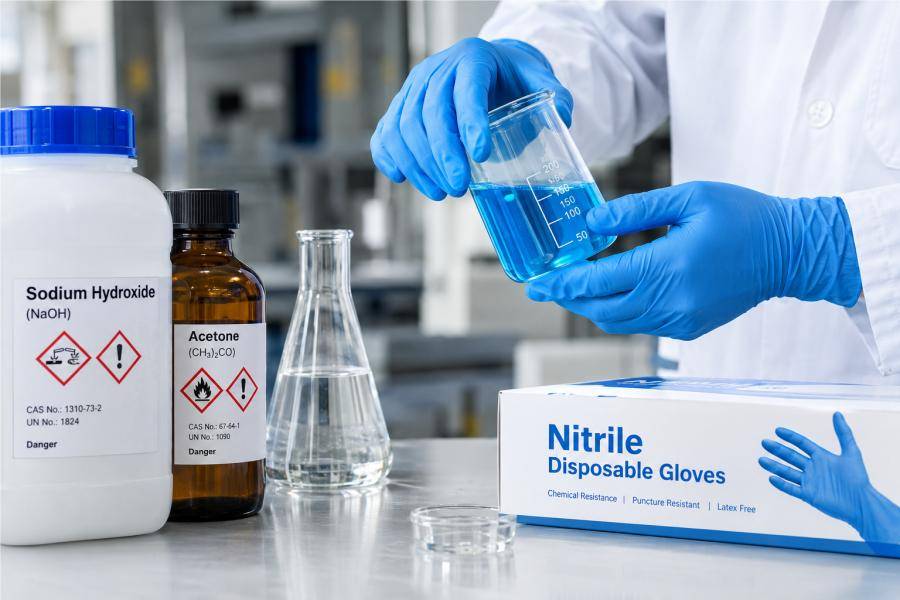
Disposable gloves are widely used in laboratories, manufacturing plants, maintenance operations, cleaning services, and chemical processing environments. However, choosing gloves for chemical handling is not as simple as selecting a thicker glove or choosing nitrile over another material.
Different chemicals can interact with glove materials in very different ways. For industrial buyers, the right choice depends on the chemical involved, exposure conditions, glove material, thickness, contact time, and the protection information provided by the manufacturer.
Quick Summary: Chemical-resistant disposable gloves should be selected according to the specific chemical and working conditions rather than thickness alone. Buyers should review chemical compatibility data, glove material, thickness, permeation and breakthrough information, sizing, packaging, and supplier documentation before placing an order.
1. Why Chemical Handling Requires the Right Glove
Chemical exposure can occur through direct contact, splashes, contaminated surfaces, or handling containers and equipment. A glove may look intact while chemicals are gradually passing through the material at the molecular level.
This is why industrial buyers should not treat all disposable gloves as interchangeable. A glove that performs well for general cleaning may not provide suitable protection against a particular solvent, acid, alkali, oil, or other chemical.
The first step is always to identify the chemicals involved and check the manufacturer's compatibility information for the specific glove construction.
2. Nitrile Is Popular, but It Is Not a Universal Chemical Barrier
Nitrile gloves are widely used in industrial applications because they offer a useful combination of puncture resistance, flexibility, tactile sensitivity, and resistance to many common substances. They are also latex-free, making them suitable for many workplaces where latex exposure is a concern.
However, nitrile should not automatically be described as suitable for every chemical. Performance varies according to the chemical, concentration, temperature, exposure time, glove formulation, and thickness.
For industrial procurement, the better approach is to use nitrile as a starting material option and then verify its performance against the chemicals used in the actual application.
3. Chemical Resistance Depends on More Than Glove Material
When comparing disposable gloves for chemical handling, buyers should consider several factors together:
Glove material: Nitrile, latex, vinyl, and other materials have different chemical resistance characteristics.
Glove thickness: Thicker gloves can provide a longer working barrier in some applications, but thickness alone does not determine chemical resistance.
Exposure time: Short accidental contact and continuous immersion create very different protection requirements.
Chemical concentration: A material may perform differently against diluted and concentrated chemicals.
Temperature: Elevated temperatures can affect material performance and chemical permeation.
Glove construction: Formulation, manufacturing quality, cuff design, and overall construction can influence practical performance.
For this reason, simply asking a supplier for the "thickest chemical-resistant gloves" is not an adequate purchasing specification.
4. Permeation, Penetration, and Degradation: What Buyers Should Understand
Chemical protection information often uses three different concepts: penetration, permeation, and degradation. Understanding the difference helps purchasing teams evaluate glove performance more accurately.
Penetration
Penetration refers to chemicals passing through physical openings or defects in the glove material, such as holes, tears, or weak points. Manufacturing quality and glove integrity are therefore important parts of chemical protection.
Permeation
Permeation occurs when a chemical passes through the glove material at a molecular level. The glove may appear intact even though the chemical is moving through the material.
Degradation
Degradation describes physical changes to the glove material caused by chemical exposure. Swelling, softening, cracking, hardening, or other changes can reduce the glove's effectiveness and usability.
5. Why Breakthrough Time Matters
Breakthrough time is an important consideration when evaluating chemical-resistant gloves. It refers to the time required for a chemical to permeate through the glove under specified test conditions.
A longer breakthrough time does not mean a glove can be worn indefinitely. Actual workplace conditions can differ from laboratory test conditions, and gloves may also be damaged by abrasion, sharp edges, heat, or other hazards.
Industrial buyers should therefore review the manufacturer's test data and establish appropriate glove replacement procedures based on the application.
6. Choosing the Right Glove Thickness
Thickness is an important purchasing factor, but it should not be used as the only indicator of chemical protection. A thicker glove may provide greater durability or longer breakthrough performance for certain chemicals, while a thinner glove may provide better dexterity for short-duration tasks.
| Application Consideration | What Buyers Should Check |
|---|---|
| Short-duration handling | Dexterity, fit, chemical compatibility, and splash protection requirements |
| Frequent chemical contact | Material compatibility, thickness, breakthrough data, and replacement frequency |
| Heavy-duty industrial work | Durability, puncture resistance, cuff length, chemical data, and overall glove construction |
For applications requiring extended chemical exposure or immersion, reusable chemical protective gloves may be more appropriate than standard disposable gloves. The product should always match the actual hazard assessment.
7. Check the Relevant Standards and Test Information
Buyers sourcing disposable gloves for industrial chemical handling should review the standards and technical documentation applicable to their market and intended use.
For example, EN ISO 374 is associated with protective gloves against dangerous chemicals and microorganisms. The specific classification and test results should be reviewed rather than relying only on a general statement such as "chemical resistant."
Importers should request relevant technical documents, test reports, declarations, and product specifications from the supplier when required for their market or customer requirements.
8. Fit and Cuff Design Also Matter
Chemical protection is not determined by the glove material alone. A poor fit can reduce dexterity and make workers more likely to remove or replace gloves incorrectly.
For industrial applications, buyers should consider available sizes, glove length, cuff design, textured grip, and overall comfort. Longer cuffs can provide additional coverage around the wrist and lower forearm in applications where this is appropriate.
Sizing should also be consistent across production batches. Inconsistent dimensions can create problems for distributors and industrial customers purchasing gloves in large quantities.
9. Quality Control Is Critical for Disposable Chemical-Handling Gloves
Chemical resistance testing is only one part of product quality. Disposable gloves must also be manufactured consistently so that users receive reliable physical protection from defects and damage.
When evaluating a supplier, industrial buyers can ask about:
Raw material control and formulation consistency
Glove thickness and dimensional tolerances
Visual inspection and defect control
Water leak or pinhole testing where applicable
Batch traceability
Packaging and carton inspection
Relevant chemical resistance and product test documentation
10. Common Industrial Applications
Disposable gloves may be used in many environments where workers handle chemicals or contaminated materials. Common applications include:
Industrial cleaning and maintenance
Automotive maintenance and repair
Laboratories and research environments
Manufacturing and assembly operations
Paint and coating operations
Chemical processing and handling
Oil and industrial maintenance applications
The required glove specification can be different for each application. Buyers should evaluate the actual substances and working conditions instead of selecting products based only on the industry name.
11. What Industrial Buyers Should Ask a Glove Manufacturer
Before placing a large order, importers and distributors should provide the supplier with as much application information as possible. Useful questions include:
Which chemicals will the gloves contact?
What are the approximate concentrations?
Is contact occasional, repeated, or continuous?
What glove material and thickness are recommended for the application?
What chemical resistance test data is available?
What sizes, colors, lengths, and packaging formats are available?
Can the supplier provide samples before bulk production?
What quality control and batch traceability procedures are used?
Clear technical communication at the beginning of the sourcing process can prevent costly product mismatches later.
12. Disposable Gloves vs. Heavy-Duty Chemical Gloves
Not every chemical-handling task requires the same type of glove. Disposable gloves are commonly selected when workers need frequent glove changes, contamination control, clean handling, or short-duration protection.
For prolonged exposure, aggressive chemicals, immersion, or applications with a high mechanical hazard, buyers may need a purpose-designed chemical protective glove with a different construction.
The purchasing decision should therefore begin with the hazard and exposure assessment, followed by material and product selection.
13. How to Source Chemical-Handling Gloves from China
For importers sourcing disposable gloves from China, supplier evaluation should cover more than unit price. A reliable supplier should be able to provide clear product specifications, consistent production quality, appropriate technical documentation, and samples for evaluation.
Buyers should also compare packaging specifications, carton quantities, production lead times, MOQ, private-label options, and shipping requirements before confirming a purchase.
For OEM or private-label projects, it is useful to confirm the glove material, thickness range, color, size range, packaging artwork, carton markings, and inspection requirements before mass production begins.
14. Final Checklist for Industrial Buyers
Identify the exact chemicals involved.
Check concentration, temperature, and exposure time.
Select a suitable glove material based on compatibility data.
Consider thickness without treating it as the only protection factor.
Review permeation, breakthrough, and degradation information where applicable.
Check relevant standards and technical documentation.
Choose the correct size, length, and cuff design.
Request samples and evaluate the gloves before bulk purchasing.
Confirm quality control, packaging, MOQ, and batch traceability with the supplier.
Conclusion
Choosing disposable gloves for chemical handling requires more than comparing glove materials or thickness. The chemical itself, concentration, exposure time, temperature, glove construction, and available test data all need to be considered together.
For industrial importers and distributors, working with a manufacturer that can provide consistent specifications, samples, quality control information, and relevant technical documentation makes the sourcing process more predictable.
A well-defined glove specification helps buyers select products that better match the actual application while reducing the risk of purchasing a glove that is unsuitable for the intended chemical exposure.
News Center
Industry News



 WhatsApp
Send us your message
You can send an email asking for the price and detailed information of this product. We will reply you as soon as we receive your email