2023/9/21
Share to:
Stitched vs. Bound Seams in Disposable Coveralls: Whats the Difference?
When sourcing disposable coveralls, buyers often focus on fabric type, protective performance, size, and price. However, garment construction is another important detail that should not be overlooked. In particular, the seam design can influence garment strength, durability, comfort, and suitability for different working environments.
Two seam construction methods commonly discussed in protective clothing manufacturing are stitched seams and bound seams. Although both methods are used to join fabric panels, they have different structures and characteristics.
Understanding the differences between stitched and bound seams can help importers, wholesalers, distributors, and PPE purchasing managers make more informed decisions when selecting disposable protective coveralls.
1. What Are Stitched Seams in Disposable Coveralls?
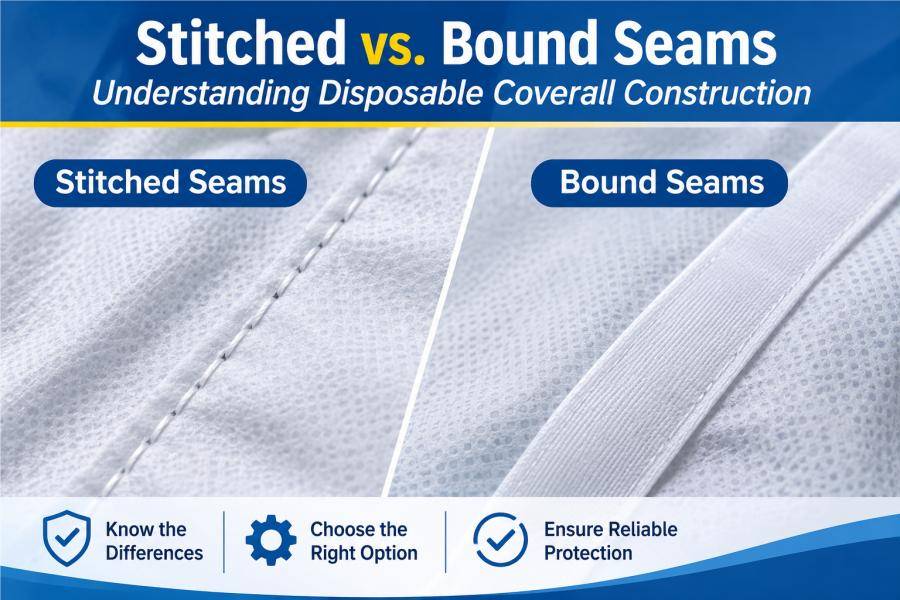
Stitched seams are created by joining two or more pieces of fabric with thread. The sewing machine forms a line of stitches along the fabric edges, holding the panels together to create the garment structure.
This is a widely used construction method in disposable protective clothing because it is practical, efficient, and suitable for different garment designs.
Key Characteristics of Stitched Seams
Thread-based construction: Fabric panels are connected using sewing thread.
Flexible structure: The seam can accommodate normal garment movement when properly designed and manufactured.
Efficient production: Conventional sewing processes can support consistent garment assembly.
Visible stitch lines: Buyers can visually inspect stitch consistency and workmanship.
Potential needle holes: The sewing process creates needle penetrations through the fabric, which may be relevant to applications requiring specific barrier performance.
Stitched seams can be suitable for general-purpose disposable coveralls and applications where the garment's overall construction meets the required workplace specifications.
2. What Are Bound Seams in Disposable Coveralls?
Bound seams are constructed by covering the joined fabric edges with an additional strip of material, commonly called binding tape. This strip is folded or wrapped around the seam allowance and secured through stitching.
The binding material covers the raw fabric edges, creating a more enclosed and finished seam appearance.
Key Characteristics of Bound Seams
Covered fabric edges: An additional strip of material encloses the seam allowance.
Finished appearance: The seam has a more covered and uniform appearance.
Edge protection: Binding can help reduce direct exposure of raw fabric edges to rubbing and handling.
Additional material: The construction uses extra binding material and an additional sewing operation.
Construction consistency: The quality depends on proper tape placement, stitching, and workmanship.
Bound seams may be selected when buyers prefer covered seam edges or when the garment design calls for this type of construction.
However, it is important to understand that a bound seam is not automatically a liquid-tight or sealed seam. The binding strip covers the seam area, but it does not necessarily eliminate needle holes or create a tested protective barrier.
3. Stitched Seams vs. Bound Seams: Key Differences
Both seam types are used to assemble protective garments, but their construction and practical characteristics are different.
| Comparison | Stitched Seams | Bound Seams |
|---|---|---|
| Construction | Fabric panels joined by thread | Joined edges covered with binding material |
| Seam Appearance | Visible stitch line and seam allowance | More enclosed, finished seam edges |
| Materials | Fabric and sewing thread | Fabric, sewing thread, and binding material |
| Production | Generally simpler sewing process | Requires an additional binding operation |
| Edge Coverage | Raw seam edges may remain exposed | Seam edges are covered by binding material |
| Barrier Performance | Depends on the complete garment construction and testing | Also depends on the complete garment construction and testing |
Neither seam type is universally better. The right choice depends on the garment design, intended application, material, manufacturing quality, and required protective performance.
4. How Does Seam Construction Affect Disposable Coverall Performance?
Seams are important structural components of disposable coveralls. Their construction can influence how the garment performs during normal workplace activities.
Garment Strength
Seams connect the different fabric panels and help maintain the garment's overall structure. Poor stitching, uneven tension, or weak seam construction may result in loose threads, skipped stitches, or seam separation during use.
For both stitched and bound seams, consistent workmanship is important.
Comfort and Flexibility
Workers may need to bend, stretch, kneel, and move repeatedly during their shifts. Seam placement, thickness, and finishing can influence how the garment feels during these movements.
Buyers should consider whether the seam construction is suitable for the intended working conditions and whether it causes uncomfortable friction or unnecessary bulk.
Fabric Edge Protection
Bound seams cover the raw fabric edges, which can help protect those edges from direct rubbing and handling. This may be useful in garment designs where a more enclosed seam finish is preferred.
However, edge coverage should not be confused with liquid or particle barrier performance. A covered seam does not automatically provide a sealed protective barrier.
Suitability for Different Applications
Different workplaces have different protection requirements. A coverall used for general maintenance may have different seam requirements from one intended for tasks involving hazardous dust or liquid splashes.
Purchasing decisions should be based on the workplace risk assessment and the garment's verified performance, rather than seam appearance alone.
5. Which Seam Type Should Buyers Choose?
The choice between stitched and bound seams depends on what the disposable coverall is designed to do.
For General Industrial Applications
Stitched seams may be a practical option for general industrial tasks where the selected garment meets the required protection specifications. Buyers should check stitch consistency, seam strength, and overall garment construction.
For Applications Requiring Covered Seam Edges
Bound seams may be preferred when the garment design calls for enclosed fabric edges and a more finished seam structure. Buyers should inspect the binding material and confirm that it is securely attached along the seam.
For Tasks Requiring Higher Barrier Performance
When protection against hazardous particles or liquid penetration is required, buyers should not select a garment based on stitched or bound construction alone.
Depending on the intended application, garments with tested taped or sealed seams may be required. Buyers should review the complete garment's classification, relevant test results, product documentation, and suitability for the specific workplace hazards.
For example, EN 14126 is relevant to protective clothing against infective agents, while EN 14605 addresses clothing protecting against liquid chemicals, including specified types of liquid-tight and spray-tight clothing. The applicable requirements depend on the task and product claim.
Always verify the applicable standard and certification for the specific garment model before purchasing.
6. What Should Importers Check Before Ordering Disposable Coveralls?
For importers, wholesalers, and distributors, checking seam construction before placing a bulk order can help reduce product quality issues and customer complaints.
Here are several practical inspection points:
Stitch consistency: Check whether stitch lines are even and whether there are skipped or loose stitches.
Seam strength: Inspect whether joined fabric panels remain securely connected during appropriate product testing.
Binding quality: For bound seams, check whether the binding strip covers the seam edges consistently and is firmly attached.
Seam appearance: Look for uneven folds, exposed edges, loose threads, and other visible defects.
Garment compatibility: Confirm that seam construction is suitable for the selected fabric and intended application.
Product documentation: Request relevant specifications, test reports, and certification documents where applicable.
Sample evaluation: Review samples before confirming large-volume orders.
It is also useful to confirm whether the supplier can maintain the same construction requirements across repeated orders. Consistency is especially important for distributors supplying the same garment model to multiple customers.
7. Why Manufacturing Details Matter When Sourcing Disposable Coveralls
For professional PPE buyers, a disposable coverall should be evaluated as a complete garment rather than by one individual feature.
Fabric selection, seam construction, garment pattern, closures, elastic components, and quality inspection all contribute to the final product.
When comparing suppliers, buyers should ask clear questions about:
Available seam construction options.
Fabric type and material specifications.
Garment size range and measurement tolerances.
Seam and garment performance testing.
Individual packaging and carton specifications.
OEM/ODM customization and production requirements.
HXProtective supplies disposable protective clothing for industrial and workplace applications. We work with international buyers to discuss product specifications, garment details, available sizes, and OEM/ODM requirements.
To learn more about our product options, visit our Microporous Coverall product page.
Looking for a Disposable Coverall Supplier?
Contact HXProtective to discuss disposable coverall specifications, available sizes, product construction, and OEM/ODM sourcing requirements.
Email: export@hxprotective.com
Website: www.hxprotective.com
Frequently Asked Questions
1. What is the main difference between stitched and bound seams?
Stitched seams join fabric panels using sewing thread. Bound seams also use stitching, but an additional strip of material covers the joined fabric edges. The main difference is the seam finishing structure.
2. Are bound seams stronger than stitched seams?
Not necessarily. Seam strength depends on fabric properties, thread, stitch type, seam design, and manufacturing quality. A bound seam provides additional edge coverage, but this does not automatically make it stronger than every stitched seam.
3. Do bound seams provide liquid protection?
Not automatically. Binding covers the seam allowance but does not necessarily seal needle holes or prevent liquid penetration. Buyers requiring liquid protection should check the complete garment's tested performance and confirm whether sealed or taped seams are necessary.
4. Are stitched seams suitable for disposable coveralls?
Yes. Stitched seams are commonly used in disposable protective clothing. Their suitability depends on the garment's design, manufacturing quality, and intended application.
5. What are taped or sealed seams?
Taped or sealed seams use a sealing material or process to cover and close the seam area. They are different from ordinary bound seams and may be used in garments designed to meet specific barrier requirements. The actual protection level must be confirmed through relevant testing.
6. What should buyers inspect when purchasing disposable coveralls in bulk?
Buyers should review fabric specifications, seam consistency, garment dimensions, closures, overall workmanship, packaging, and relevant test documentation. Sample evaluation is recommended before placing large orders.
News Center
Industry News



 WhatsApp
Send us your message
You can send an email asking for the price and detailed information of this product. We will reply you as soon as we receive your email