2023/9/21
Share to:
Demystifying "Type" Standards: A Comprehensive Guide to Type 3, 4, 5, and 6 Protective Apparel
In the global Personal Protective Equipment (PPE) market, the European "Type" classification system is the gold standard for defining the barrier performance of chemical protective clothing. Understanding these designations—specifically Types 3, 4, 5, and 6—is the difference between a safe workforce and a catastrophic exposure incident.
1. The Hierarchy of Protection: Breaking Down the Types
Each "Type" corresponds to a specific European standard (EN) and represents a different level of protection against various physical forms of hazards.
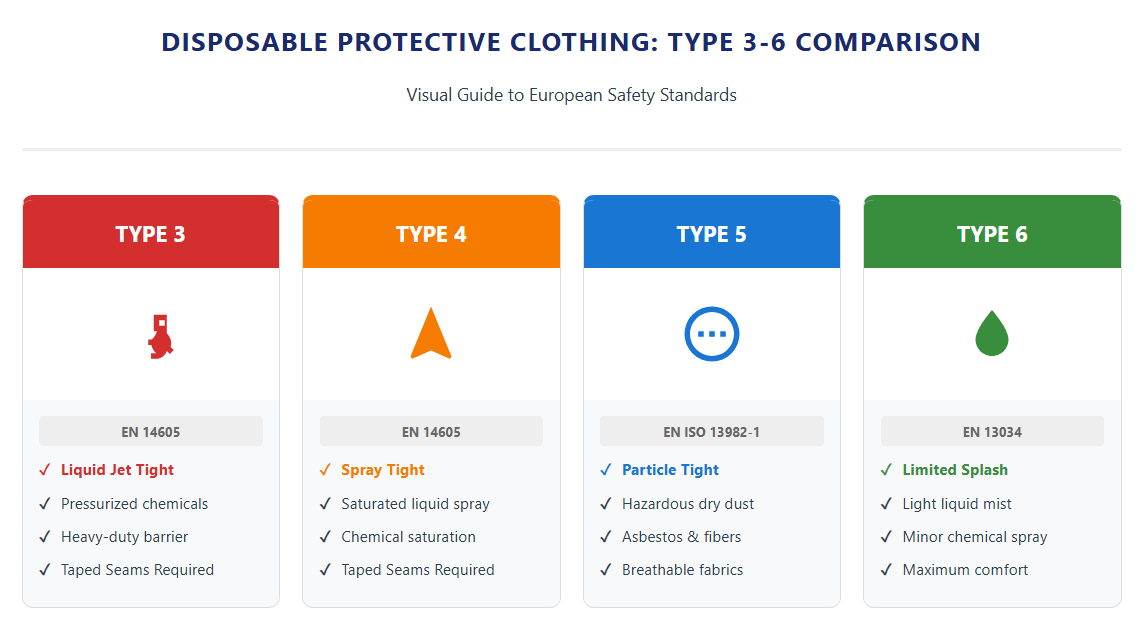
Type 6: Light Spray Tight (EN 13034)
The Standard: Protection against limited liquid splashes and mists.
The Hazard: Low-pressure, low-volume liquid chemicals or accidental light sprays.
Ideal For: General industrial maintenance, laboratory work, logistics, and light-duty cleaning.
Material: Usually SMS or Microporous film with serged seams.
Type 5: Particle Tight (EN ISO 13982-1)
The Standard: Protection against hazardous dry particulate matter.
The Hazard: Airborne solid particles, such as asbestos, lead dust, or pharmaceutical powders.
Ideal For: Construction, pharmaceutical manufacturing, wood processing, and waste remediation.
Material: High-density fabrics designed to prevent "inward leakage" of microscopic fibers.
Type 4: Spray Tight (EN 14605)
The Standard: Protection against saturated liquid chemical sprays.
The Hazard: Continuous or heavy spray of liquid chemicals that may pool on the garment.
Ideal For: Industrial pressure washing, chemical tank cleaning, and agricultural spraying.
Key Feature: Requires taped seams (heat-sealed tape over the stitching) to prevent liquid from wicking through needle holes.
Type 3: Liquid Tight (EN 14605)
The Standard: Protection against pressurized jets of liquid chemicals.
The Hazard: Strong, directed jets of hazardous liquids (e.g., from a burst pipe or high-pressure hose).
Ideal For: Emergency chemical response, hazardous waste disposal, and high-risk chemical handling.
Key Feature: Usually made from heavy-duty coated fabrics with robust, liquid-proof closures and seams.
2. Selection Guide: Matching the Suit to the Environment
Choosing the right garment requires a thorough risk assessment of your specific work environment. Use the following table as a quick reference:
| Work Environment | Primary Hazard | Recommended Type |
|---|---|---|
| Pharmaceutical Lab | Fine powders & light mist | Type 5/6 |
| Asbestos Removal | Hazardous dry fibers | Type 5 |
| Automotive Painting | Paint mist & solvent splash | Type 6 |
| Chemical Transfer | Saturated liquid spray | Type 4 |
| Tank Cleaning | High-pressure liquid jets | Type 3 |
3. Critical Factors for B
When evaluating suppliers, keep these three professional tips in mind:
Dual or Multi-Rating: Most high-quality disposable coveralls are dual-rated (e.g., Type 5/6). This offers versatility for environments where both dust and light splashes are present.
Seam Construction Matters: For Type 5/6, serged seams are standard. However, for Type 4 and above, taped seams are mandatory to ensure the "Spray Tight" integrity of the garment.
Chemical Permeation Data: The "Type" tells you the physical form of the hazard the suit can block, but it does not tell you how long the fabric resists a specific chemical. Always ask your manufacturer for a Permeation Breakthrough Data Sheet for the specific chemicals used in your facility.
Conclusion: Safety Through Compliance
Selecting the correct "Type" of protective clothing is not just about ticking a box for compliance—it is about understanding the physics of the hazard. Whether you are dealing with invisible dust or high-pressure chemical jets, ensuring your PPE matches the EN standard is the most effective way to protect your most valuable asset: your people.
News Center
Industry News



 WhatsApp
Send us your message
You can send an email asking for the price and detailed information of this product. We will reply you as soon as we receive your email