2023/9/21
Share to:
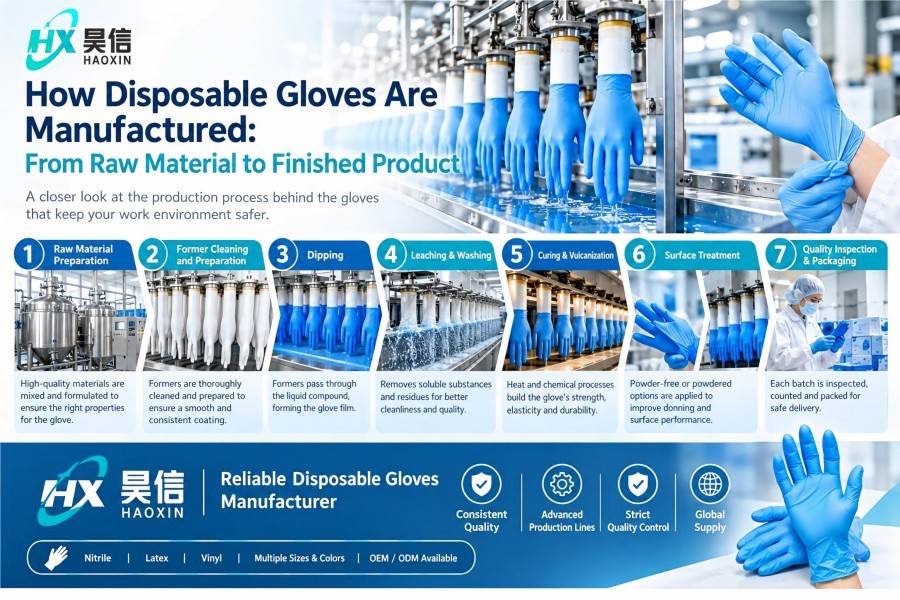
How Disposable Gloves Are Manufactured: From Raw Material to Finished Product
Disposable gloves are used across healthcare, food processing, manufacturing, cleaning, and industrial workplaces. For importers and distributors, understanding how disposable gloves are manufactured can help when evaluating suppliers, comparing product specifications, and maintaining consistent purchasing quality.
The manufacturing process involves more than dipping a glove-shaped former into liquid material. Raw material preparation, forming, leaching, curing, surface treatment, inspection, and packaging all influence the final product.
This guide explains the main steps involved in manufacturing disposable nitrile gloves, with additional notes on how production may differ for other glove materials. It also covers the quality checks and supplier questions that matter when purchasing disposable gloves in bulk.
Quick Overview
Disposable glove manufacturing generally includes raw material preparation, former cleaning, dipping, leaching, curing, surface treatment, stripping, inspection, and packaging. The exact process depends on the glove material, product design, and manufacturer’s production system.
1. What Materials Are Used to Manufacture Disposable Gloves?
The first step in disposable glove manufacturing is selecting the appropriate raw material. Different materials offer different combinations of flexibility, chemical compatibility, tactile sensitivity, and production characteristics.
Common disposable glove materials include nitrile, natural rubber latex, and vinyl. The selection depends on the intended application, required performance, customer specifications, and applicable regulations.
Nitrile Gloves
Nitrile is a synthetic rubber widely used for disposable examination, industrial, cleaning, and food-handling gloves. It offers a balance of flexibility and resistance to many common oils and chemicals, although performance must be verified for the specific substance and exposure conditions.
Nitrile gloves are available in different thicknesses, colors, textures, and surface finishes. These options allow manufacturers to develop products for different workplace requirements.
Latex Gloves
Natural rubber latex is known for its elasticity and tactile performance. Latex gloves may be used in medical, examination, and other applications, subject to the relevant product requirements and user considerations.
Because natural rubber latex contains proteins that can cause allergic reactions in some individuals, buyers should consider customer requirements and appropriate product labeling.
Vinyl Gloves
Vinyl gloves are made from polyvinyl chloride (PVC) and plasticizing components. They are commonly used for selected low-risk, short-duration tasks where their performance characteristics meet the application requirements.
Compared with elastomeric gloves, vinyl gloves have different stretch, fit, and barrier characteristics. Buyers should evaluate the intended use rather than assuming that all disposable glove materials provide equivalent protection.
2. Raw Material Preparation
For dipped nitrile and latex gloves, the manufacturing process begins with preparing a liquid compound. The compound is formulated and mixed according to the manufacturer’s specifications.
Depending on the formulation, ingredients may include the primary polymer, stabilizers, curing agents, pigments, and other processing components.
The objective is to produce a compound with suitable properties for the dipping and curing stages. Mixing conditions, material consistency, and storage controls can affect the quality of the finished gloves.
Important Production Controls
Raw material identification and traceability
Compound formulation and mixing consistency
Storage conditions and material handling
Viscosity or other applicable process checks
Batch documentation and production records
For importers, asking how a manufacturer manages raw material batches can provide useful information about production consistency and quality management.
3. Former Cleaning and Preparation
Disposable gloves are formed on hand-shaped molds, commonly called formers. Formers determine the glove’s basic shape, dimensions, and fit characteristics.
Before dipping, the formers must be cleaned and prepared for the production process. Residues or contamination on the former surface can affect the coating and may lead to production defects.
Manufacturers may use cleaning, rinsing, and conditioning steps as part of their former preparation system. The specific methods depend on the production line and material requirements.
Why Former Preparation Matters
Supports consistent glove formation
Helps reduce surface contamination
Contributes to uniform coating quality
Supports stable production performance
A consistent former preparation process is one part of maintaining stable quality across large production batches.
4. Dipping: How the Glove Shape Is Formed
Dipping is a central stage in the production of nitrile and latex gloves. Prepared formers pass through the liquid glove compound, allowing a layer of material to form on the surface.
The production line controls factors such as dipping conditions, material properties, and processing speed. These variables influence the amount of material deposited and the consistency of the glove coating.
Depending on the product design, additional dipping or coating operations may be used to achieve the required thickness or construction.
Factors That Influence Glove Thickness
Compound properties
Dipping conditions
Production line speed
Former design
Number of coating operations
Processing and curing conditions
Glove thickness is not necessarily uniform across every part of a glove. Palm, fingertip, and cuff measurements may differ according to product design. Buyers should confirm the supplier’s specified measurement locations and tolerances.
For a more detailed discussion of thickness selection, see: Nitrile Glove Thickness Guide: 3 Mil vs 5 Mil vs 7 Mil.
5. Leaching and Washing
After the initial coating and film formation stages, dipped gloves may undergo leaching or washing operations. These steps help remove selected water-soluble substances and processing residues from the glove film.
The exact washing and leaching sequence depends on the glove material, formulation, and production process.
Manufacturers control the relevant process conditions to support product consistency and meet applicable quality requirements.
What Buyers Should Understand
Washing and leaching are process-specific operations.
They do not guarantee resistance to every chemical or contaminant.
Final product performance depends on formulation and the complete manufacturing process.
Relevant testing and specifications should be reviewed for the intended application.
6. Curing and Vulcanization
Curing is a key stage in the production of many elastomeric gloves. During this process, the material develops its intended physical properties through controlled processing conditions.
For nitrile and natural rubber latex gloves, curing systems commonly involve heat and chemical cross-linking. The formulation and curing conditions influence properties such as elasticity, strength, and durability.
The manufacturer must establish appropriate curing conditions for the specific glove compound and product design.
Quality Factors Related to Curing
Tensile strength
Elongation
Elastic recovery
Film integrity
Consistency between production batches
Insufficient or inconsistent processing can affect the final glove’s physical performance. This is why process control and finished-product testing are important when selecting a manufacturing partner.
7. Surface Treatment: Powder-Free and Powdered Gloves
Surface treatment is used to achieve the handling characteristics required by the finished glove. Depending on the product, manufacturers may use different methods to improve donning, reduce tackiness, or modify the glove surface.
Powder-Free Gloves
Powder-free gloves are processed without intentionally adding powder as a donning aid in the finished product. Various surface treatments may be used to improve ease of use.
Common approaches include chlorination or polymer coating, depending on the material and product design.
Powdered Gloves
Powdered gloves contain a powder used to assist donning. However, their suitability depends on the application and applicable requirements. Some healthcare and workplace settings restrict or prohibit powdered gloves.
Buyers should confirm the glove’s surface treatment, powder status, and relevant market requirements before placing an order.
Related reading: Powder-Free vs Powdered Gloves: What Buyers Need to Know.
8. Glove Stripping and Cuff Finishing
After the glove film has completed the necessary processing stages, the gloves are removed from the formers. This operation is commonly referred to as stripping.
The gloves then undergo additional finishing operations as required by the product design. These may include cuff rolling, trimming, or other handling steps.
The cuff design affects how the glove fits and how it is handled during use. Finishing quality also influences the appearance and consistency of the final product.
Checks During Finishing
Cuff appearance and consistency
Visible defects
Glove dimensions
Surface condition
Product identification and handling
Manufacturers may use manual, automated, or combined processes depending on their equipment and production requirements.
9. Quality Inspection: How Disposable Gloves Are Checked
Quality inspection is essential for disposable glove manufacturing. A product that looks acceptable may still require testing to verify its physical properties, dimensions, and other specified requirements.
The inspection program should reflect the intended application, customer specifications, and applicable standards or regulations.
Visual Inspection
Visual inspection can identify visible defects such as holes, tears, surface irregularities, contamination, and inconsistent appearance.
Manufacturers may inspect gloves at different stages of production, including after stripping and before packaging.
Physical Performance Testing
Depending on the product and applicable requirements, physical testing may include:
Tensile strength
Elongation
Dimensions and thickness
Water-tightness or leak testing, where applicable
Other product-specific performance checks
Testing methods, acceptance criteria, and sampling plans should be documented and appropriate for the product being manufactured.
Why Batch Consistency Matters
For importers and distributors, consistent quality across different production batches is important. Changes in thickness, sizing, surface finish, or packaging can affect customer satisfaction and product suitability.
Buyers should ask suppliers how they record inspection results and handle nonconforming products.
10. Packaging and Finished Product Preparation
After inspection, disposable gloves are counted and packaged according to the product specification. Packaging may include individual or bulk packing, dispensing boxes, inner bags, and shipping cartons.
The final packaging configuration depends on the glove type, customer requirements, market, and distribution process.
Common Packaging Information
Glove material and product type
Size and quantity
Color and surface treatment
Batch or lot identification
Manufacturer information
Applicable labeling and documentation
For private-label buyers, packaging artwork and labeling should be confirmed before mass production. Any required regulatory information must be reviewed for the destination market.
11. How Long Does Disposable Glove Manufacturing Take?
Production lead time depends on several factors, including the product specification, order quantity, raw material availability, production schedule, packaging requirements, and inspection arrangements.
Standard products may follow a different production schedule from customized or private-label orders.
For importers, it is useful to discuss the complete order timeline rather than focusing only on the time required for glove production.
Factors Affecting Lead Time
Product type and thickness
Required sizes and colors
Order quantity
Custom packaging and printing
Quality inspection requirements
Shipping and export arrangements
A manufacturer should provide a realistic production schedule and communicate any changes that may affect delivery.
12. What Importers Should Ask Disposable Glove Manufacturers
Choosing a disposable glove supplier involves more than comparing unit prices. Buyers should review product specifications, quality controls, manufacturing capabilities, and supply arrangements.
1. What Glove Materials Do You Offer?
Ask whether the manufacturer produces nitrile, latex, vinyl, or other relevant glove types. Confirm which products are manufactured in-house and which may be sourced from another supplier.
2. Can You Provide Product Specifications?
Request details such as material, thickness, sizes, colors, cuff design, surface treatment, and packaging configuration. Make sure the specification matches your intended market and application.
3. How Do You Manage Quality Control?
Ask about raw material inspection, in-process controls, finished-product testing, and batch traceability. If your order requires specific acceptance criteria, confirm them before production.
4. Do You Support OEM and Private Label Orders?
For distributors and brand owners, discuss custom packaging, carton artwork, product colors, labeling, and production requirements. Confirm the approval process for packaging and product samples.
5. Can You Provide Relevant Documentation?
Depending on the destination market and product application, buyers may need technical documents, test reports, declarations, or other supporting records. Ask the supplier which documents are available for the specific product.
13. Disposable Glove Manufacturing and Product Standards
Disposable glove standards vary according to the intended use and target market. A manufacturer’s production process alone does not establish compliance with a particular standard.
Importers should identify the applicable requirements for their destination market and product category before placing an order.
For example, medical examination gloves, industrial protective gloves, and food-contact gloves may be subject to different requirements. The relevant documentation should be assessed against the product’s intended use.
For an overview of selected glove standards, see: Disposable Gloves Standards Explained: EN455, EN374 & ASTM Guide.
14. Disposable Glove Manufacturing: Common Buyer Mistakes
Some purchasing problems arise when buyers evaluate gloves using only one factor, such as price or nominal thickness.
Mistake 1: Comparing Prices Without Matching Specifications
Two gloves may have different thicknesses, sizes, packaging quantities, or performance requirements. Comparing prices without confirming the specifications can lead to misleading cost comparisons.
Mistake 2: Assuming Thickness Guarantees Chemical Protection
A thicker glove is not automatically resistant to every chemical. Chemical resistance depends on the material, formulation, thickness, exposure conditions, and testing data.
Mistake 3: Skipping Sample Approval
Before placing a large order, buyers should evaluate representative samples against their agreed specifications. Sample approval should include the relevant product and packaging details.
Mistake 4: Ignoring Packaging and Labeling Requirements
Incorrect quantities, labeling, or packaging information can create problems during importation and distribution. These requirements should be confirmed before mass production.
15. Frequently Asked Questions
Q1: What is the main material used to manufacture disposable nitrile gloves?
Nitrile gloves are made from synthetic nitrile rubber compounds. Manufacturers formulate and process the compound to achieve the required product characteristics.
Q2: Are all disposable gloves manufactured using the dipping process?
No. Dipping is commonly used for nitrile and latex gloves, but manufacturing methods vary by material and product design. Vinyl gloves, for example, follow a different production process.
Q3: How do manufacturers control disposable glove quality?
Quality control may include raw material checks, process monitoring, visual inspection, physical testing, and packaging verification. The exact inspection program depends on the product and applicable requirements.
Q4: Can disposable glove manufacturers produce custom products?
Many manufacturers offer options such as different colors, sizes, thicknesses, packaging configurations, and private-label services. Available customization depends on the supplier’s production capabilities and order requirements.
Q5: How can importers evaluate a disposable glove supplier?
Review the supplier’s product specifications, quality control process, production capabilities, relevant documentation, packaging options, and communication. Sample evaluation and clear purchase specifications can help reduce misunderstandings.
16. Why Work with an Experienced Disposable Glove Manufacturer?
For importers and distributors, a manufacturing partner should provide more than a product quotation. Consistent specifications, clear communication, quality management, and reliable order coordination all contribute to a smoother purchasing process.
An experienced supplier can help buyers review suitable glove options, confirm product requirements, and coordinate packaging and production arrangements.
However, buyers should evaluate supplier capabilities based on documented information, product samples, and the requirements of their specific market.
Looking for a Disposable Glove Manufacturing Partner?
HXProtective supports global PPE buyers, importers, and distributors seeking disposable glove solutions for different applications.
Discuss your product requirements with our team, including glove material, thickness, sizing, packaging, and OEM needs.
Email: export@hxprotective.com
Website: www.hxprotective.com
Conclusion
Disposable glove manufacturing involves a series of controlled production and inspection steps. For nitrile gloves, these commonly include compound preparation, former cleaning, dipping, leaching, curing, surface treatment, stripping, and packaging.
Each stage contributes to the finished product’s characteristics and consistency. The actual process varies according to the material, product design, and manufacturing system.
For importers and distributors, understanding the manufacturing process provides a useful starting point for evaluating suppliers. Clear specifications, sample approval, relevant testing, and reliable quality documentation are important parts of a successful purchasing process.
Related Articles
News Center
Industry News



 WhatsApp
Send us your message
You can send an email asking for the price and detailed information of this product. We will reply you as soon as we receive your email